EXIST 2026 - Physiological Data for Multimodal Sexism Characterization in Social Media
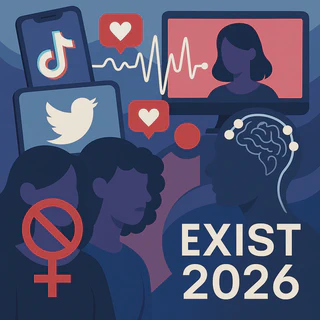 EXIST 2026: Towards Human-Centric AI through multimodal and physiological data.
EXIST 2026 will mark the sixth edition of the sEXism Identification in Social neTworks challenge, continuing its mission to advance the automatic detection and characterization of sexism across social media.
This edition introduces a major innovation: the inclusion of physiological and neurophysiological data —such as heart rate, EEG, and eye-tracking signals— collected from participants while viewing potentially sexist content.
The lab, to be held at CLEF 2026, will include six tasks (in English and Spanish) combining memes and TikTok videos, covering:
- Sexism identification (binary classification)
- Source intention detection (direct vs. judgmental sexism)
- Sexism categorization (ideological inequality, stereotyping, objectification, sexual and non-sexual violence)
These multimodal resources will help researchers analyze both explicit and implicit reactions to sexist content, connecting emotional and cognitive responses with linguistic and visual patterns.
By incorporating sensor data into AI training, the challenge aims to create more human-aligned and context-aware systems, capable of detecting subtle cues of bias or discomfort beyond textual or visual content alone.
This initiative is jointly organized by UNED (Spain) and UPV (Spain), with the collaboration of ValgrAI and RMIT University (Australia), as part of the ANNOTATE Project.
👉 Visit the official site: https://nlp.uned.es/exist2026/
📢 More details will be announced soon!
🧠 Keywords: sexism identification · multimodal AI · EEG · eye tracking · heart rate · learning with disagreement · human-centric AI